How Much Floor Space Do You Need for a Baby Play Mat?
Quick answer: A baby play mat needs a clear floor area that accommodates its full intended footprint, plus the walking routes and caregiver space your room requires. Measure that usable area after accounting for furniture and door movement, then compare both sides with the exact mat's listed dimensions.
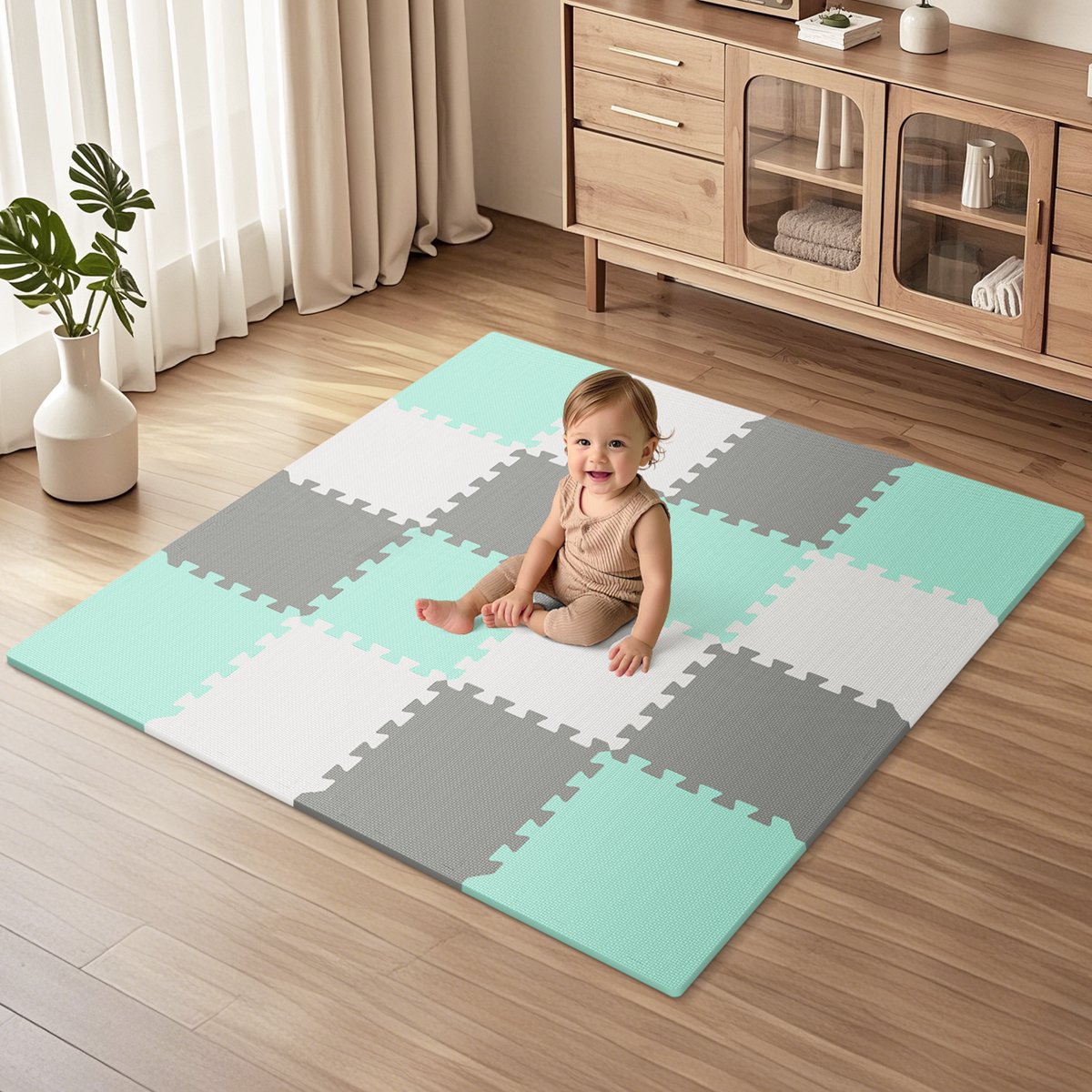
Room size is the starting measurement
A room can look spacious while offering only a narrow strip of open floor. Sofas, tables, shelving and doors all affect what you can use. Record the room's length and width, but keep a second pair of measurements for the rectangle actually available for the mat.
Use inches throughout the comparison if the product is listed in inches. Mixing feet, inches and centimeters on the same sketch can hide a simple mismatch. Write the units beside every number. You can convert later, but the ordering decision should use one consistent set of measurements.
Measure the room in five practical steps
1. Sketch the fixed features
Draw a simple outline and mark the doorway, furniture and items that stay in place. Include anything that projects into the floor area at mat level. You do not need a professional floor plan; you need enough detail to avoid treating occupied floor as available space.
2. Check furniture in everyday use
Open the doors and drawers you normally use, and pull out a chair if that changes the layout. Measure from the part that extends farthest into the proposed area. A measurement taken while everything is closed may describe a room arrangement you cannot keep during the day.
3. Reserve the walking route
Decide how people will enter, leave and cross the room. Keep that route outside the proposed play area. This guide does not assign a universal aisle width: your household, furniture and any applicable accessibility requirements determine the space you need. Try the route before settling on the mat position.
4. Give the caregiver a real place
Include room for an adult to sit alongside the mat and get up again. If you have only measured the product rectangle, this part may be missing. Ask another caregiver to try the proposed position too; a layout should work for the people who will actually use it.
5. Measure the remaining rectangle
Measure the clear length and width after those allowances. Check at more than one point if the space narrows around furniture. Compare the narrowest usable dimensions with the product's intended footprint, then consider whether rotating a rectangular mat helps.
Room dimensions to a PIGLOG shortlist
The examples below are planning exercises, not minimum room sizes or fit guarantees. The reserved areas are hypothetical household choices, not recommended clearance distances. Two rooms with identical outer dimensions can produce different usable areas because their furniture and routes differ.
| Example room | Measured clear rectangle after household allowances | Product to check | Dimension comparison |
|---|---|---|---|
| 8 x 10 ft room (96 x 120 in) | 54 x 54 in | 16-piece EVA tiles, about 49.6 x 49.6 in | 4.4 in remains across each dimension in this example |
| 10 x 12 ft room (120 x 144 in) | 84 x 76 in | Rainbow & Stars foldable mat, about 79 x 71 in | 5 in remains across each dimension in this example |
| 12 x 12 ft room (144 x 144 in) | 80 x 80 in | 36-piece tiles in a 6 x 6 layout, about 74.4 x 74.4 in | 5.6 in remains across each dimension in this example |
| Any room size | One side is shorter than the proposed mat in both orientations | Recheck another listed size or permitted layout | Room area alone does not establish fit |
The remaining inches in the last column are totals across a dimension, not the distance on every side. They are arithmetic differences, not prescribed clearances. The adult position and walking route have already been reserved before measuring the clear rectangle in these examples.
Read the product dimensions carefully
The Rainbow & Stars foldable example is approximately 79 x 71 in and 0.4 in thick. The 16-piece EVA set lists 12.4 x 12.4 in tiles and 0.6 in thickness, with an assembled square of about 49.6 x 49.6 in. These are specific models, not measurements to apply to an entire category.
The 36-piece interlocking set lists 12.4 x 12.4 in tiles, 0.6 in thick. A 6 x 6 arrangement is about 74.4 x 74.4 in. If you consider another arrangement, check the instructions and measure the completed outline. The number of pieces alone does not describe its length and width.
Use the PIGLOG play mat comparison to shortlist sizes. Keep approximate dimensions approximate, and check the current listing before ordering. If your available area is an exact match with no room to accommodate variation, ask about the product rather than assuming a precise fit.
Rehearse the footprint before ordering
Mark the proposed corners using a removable method suitable for your floor, then clear the markers away after measuring. Walk around the outline, use the nearby furniture and try the caregiver position. This gives the numbers a physical meaning that a product photo cannot provide.
Repeat the check with the rectangle rotated when comparing a foldable mat. A 79 x 71 in product needs one side to accommodate 79 in and the other 71 in. Having enough total square footage does not compensate for a side that is too short.
Include the route to storage
A mat also needs a workable plan between sessions. Check where it will be folded or taken apart and how you will reach its storage location. Open thickness does not tell you the folded package size or the space required by a stack of tiles.
If the floor area changes during the day, note which furniture must move and whether that routine is realistic. Our foldable versus interlocking guide compares setup, joins, handling and storage so the format decision follows your room plan.
Keep the intended use clear
PIGLOG play mats are for supervised awake play only. For infant sleep information, refer to the American Academy of Pediatrics guidance.
Frequently asked questions
Can I choose a mat from my room's square footage?
Use the clear length and width instead. Furniture, door movement, walking routes and caregiver space determine the usable rectangle; total room area does not capture those constraints.
Do the table examples set required clearance distances?
No. They illustrate arithmetic using hypothetical layouts. Decide the allowances your room requires, then measure the remaining space and follow the product instructions.
What should I check if the mat will go inside a playpen?
Measure the usable interior and consult the playpen manufacturer's instructions. Matching a nominal size does not establish compatibility or replace those instructions.
Browse foldable play mats and interlocking floor tiles with your measurements beside you, then check the exact product before ordering.